
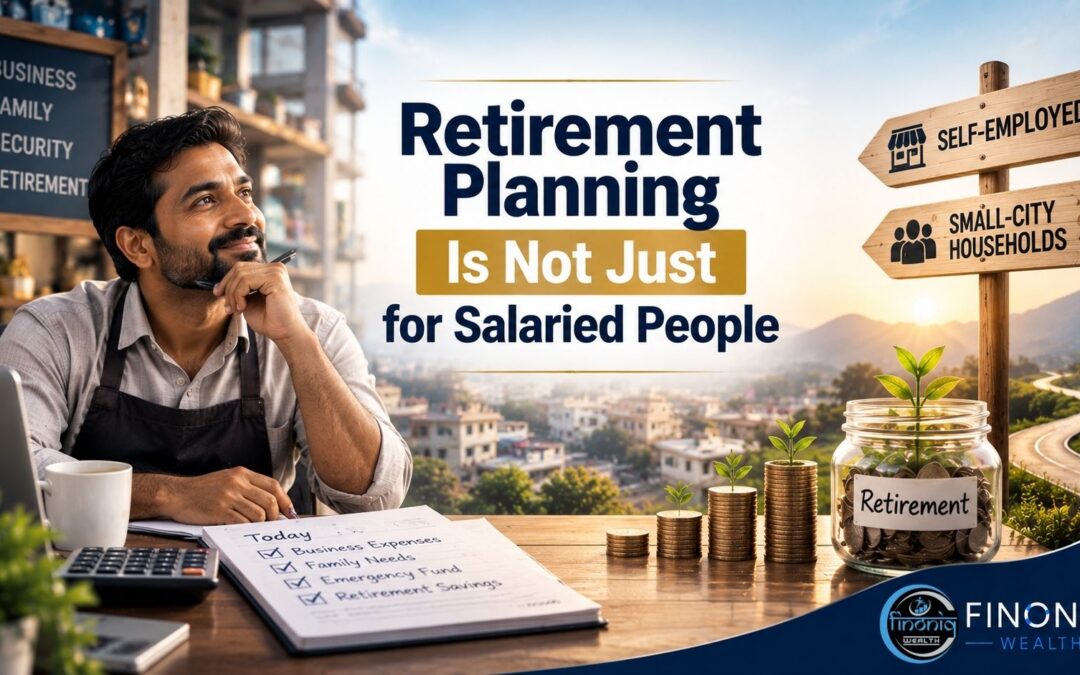
Imagine a 38-year-old shop owner in a growing Indian city.
The shop is doing reasonably well. Some months bring strong sales, while other months are slower. The family has regular expenses, children’s education to think about, a home loan to manage and unexpected business costs to handle.
Whenever money is left over, the owner uses it for business expansion, household needs or a family commitment.
Retirement, meanwhile, feels like something to think about later.
Unlike a salaried employee who may receive retirement benefits through an employer, this business owner may have to create a retirement savings habit independently.
The same situation can apply to freelancers, consultants, doctors running private practices, traders and small-business owners.
But a recent report suggests that retirement-focused purchases are attracting attention beyond traditional salaried households.
According to Business Standard, retirement-product purchases on Pension bazaar increased by more than 50% in September 2026 compared with April. The platform’s analysis also found that 30% of buyers were self-employed and 60% of purchases came from Tier II and Tier III cities combined. In September, 80% of buyers chose monthly contributions.
These figures describe activity on one platform, not a representative survey of all Indian households. Still, they offer an interesting starting point for understanding changing retirement-saving habits.
The important question is not simply whether retirement products are becoming more popular.
It is this: How can people with irregular income prepare for retirement without leaving themselves short of money when an emergency arises?
Introduction: Retirement Planning Is Not an Employee-Only Activity
Retirement planning is often associated with a monthly salary, provident fund contributions and employer-sponsored benefits.
For self-employed people, the process can look very different.
Income may depend on customer payments, seasonal demand, project completion or business performance. A good month does not necessarily mean that the same income will continue next month.
This uncertainty can make long-term saving feel difficult.
However, retirement is a financial stage that salaried and self-employed people may both eventually face. The difference is that self-employed individuals often need to take greater responsibility for organising their own retirement savings.
That does not mean every business owner needs to contribute the same amount every month.
It means creating a system that recognises three realities:
- Current household expenses must be paid.
- Unexpected costs can arise at any time.
- Retirement savings need time and consistency to develop.
The challenge is to balance these needs instead of treating every rupee left in the bank as money available for long-term investment.
1. Why Retirement Planning Can Be Different for Self-Employed People
Income may be irregular
A salaried employee may receive a predictable salary date. A self-employed person might receive payments from several customers at different times.
For example, a consultant could earn ₹1.2 lakh in one month and ₹55,000 in another. A shop owner may experience higher sales during festival periods and weaker sales during other months.
If retirement contributions are based only on the best month, the commitment may become difficult to maintain.
A more useful starting point is to understand the household’s essential expenses, business cash-flow needs and income patterns across several months.
Business money and personal money can become mixed
Small-business owners sometimes use the same bank account for business receipts, household expenses and personal savings.
This can make it difficult to understand how much money is genuinely available for long-term goals.
Separating business operating funds from household spending and personal savings can improve visibility. It also helps prevent money needed for stock purchases, salaries, rent or taxes from being treated as retirement money.
Employer-linked retirement benefits may be absent
Some salaried employees have access to employer-linked retirement arrangements. A self-employed individual may not have an equivalent arrangement through an employer.
That makes independent organisation particularly important.
The first step is not necessarily choosing a financial product. It is understanding what retirement resources already exist, what expenses may continue later in life and how much flexibility the household needs.
2. Why Small-City Households Should Pay Attention
Retirement planning is not limited to people living in large metropolitan cities or earning high salaries.
Small-city households may have different cost structures, housing arrangements, family responsibilities and income sources. Some own businesses; others earn through independent professional work or family enterprises.
The Pension bazaar figures reported by Business Standard showed that Tier II and Tier III cities together accounted for 60% of purchases on that platform in September 2026.
This is a useful observation, but it should not be interpreted as proof that 60% of Indian retirement savers live in smaller cities. It represents the platform’s reported purchase distribution.
The broader lesson is that retirement awareness is relevant wherever people earn and spend money.
Even when a household owns a home or business, those assets do not automatically provide a predictable income throughout retirement. Their future usefulness depends on factors such as expenses, maintenance, liquidity and whether they generate income that can support daily living.
Retirement preparation therefore involves looking beyond today’s income and considering how future expenses may be met.
Part 2: How Self-Employed People Can Build Retirement Savings Without Ignoring Emergencies
3. How Can You Save for Retirement When Income Changes Every Month?
The first challenge is deciding how to save when income is unpredictable.
Consider a small-business owner whose monthly income varies considerably. Committing to the same contribution every month may feel manageable during a good period but stressful when sales decline.
One way to approach this challenge is to build a contribution system around actual cash flow rather than assuming that every month will be the same.
Step 1: Understand essential household expenses
Start by identifying expenses that need to be covered regardless of business performance.
These may include:
- Household food and utilities
- Rent or home-loan payments
- School and education expenses
- Insurance premiums
- Essential transport and medical costs
- Other unavoidable commitments
Understanding these expenses creates a clearer picture of how much income the household needs to function.
Step 2: Separate business operating money
Money received by a business is not necessarily personal income.
A shop owner may need funds for inventory, rent, employee payments, taxes and supplier bills. Using this money for long-term retirement contributions could create cash-flow difficulties later.
A clear separation between business funds and household finances can help avoid this confusion.
Step 3: Establish a contribution method that allows flexibility
Instead of assuming that a fixed contribution is always possible, a self-employed person can first review income patterns and essential expenses.
For example, a business owner may establish a modest regular contribution during ordinary months and review whether additional saving is possible after stronger months.
The amount and frequency depend on the household’s circumstances. The key educational lesson is to make the process realistic enough to continue without compromising essential commitments.
Consistency does not require pretending that income is consistent.
4. Why Emergency Liquidity Matters Before Long-Term Saving
Imagine that a small-business owner has put most available savings into a long-term retirement arrangement.
A few months later, a family medical expense arises, or business sales suddenly decline.
If the household has insufficient accessible savings, it may need to borrow money or withdraw from a long-term investment at an inconvenient time.
This illustrates why retirement saving and emergency preparation should be considered together.
What is an emergency fund?
An emergency fund is money kept accessible for unexpected expenses or temporary income disruptions.
For self-employed households, possible triggers include:
- A sudden fall in customer demand
- Delayed payments from clients
- Essential equipment repairs
- Medical expenses
- Unexpected household costs
The amount of accessible savings required varies according to income stability, essential expenses, family responsibilities and business risks.
A person whose income changes significantly from month to month may have different liquidity needs from someone with a stable salary.
Why liquidity and retirement savings serve different purposes
Emergency money is intended to help meet unexpected near-term needs. Retirement savings are intended to support expenses much later in life.
Treating these two purposes as interchangeable can create problems.
Money committed to a long-term arrangement may not be immediately available, may have withdrawal conditions or may experience market-value fluctuations.
Understanding these differences helps households organise their money according to when it may be needed.
5. Practical Example: A Small-Business Household
Consider a hypothetical household in which one person runs a small retail business.
Monthly earnings vary, and the family has both regular household expenses and business operating costs.
Rather than beginning with a retirement product, the household could organize its finances into distinct categories.
| Financial Category | Main Purpose |
| Business operating funds | Inventory, suppliers, rent and other business expenses |
| Household spending | Regular family expenses and essential commitments |
| Emergency savings | Unexpected costs and income disruptions |
| Retirement savings | Long-term expenses after working income reduces |
| Other planned goals | Education, home repairs or other future commitments |
This is an organisational example, not a prescribed allocation.
The actual amounts depend on the household’s cash flow, existing savings, obligations and time horizon.
The benefit of this approach is visibility. It becomes easier to distinguish money needed soon from money being set aside for the future.
6. Common Misconceptions About Retirement Planning
Misconception 1: Retirement planning is only for salaried employees
Retirement is a life stage, not an employment category.
Self-employed people may need to organise retirement resources independently, particularly where they do not have employer-linked retirement benefits.
Misconception 2: You must contribute the same amount every month
A consistent habit can be helpful, but irregular income requires realistic cash-flow management.
The contribution approach needs to account for essential expenses and periods when income is weaker.
Misconception 3: Owning a business means retirement is already taken care of
A business may have value, but its value is not automatically the same as spendable retirement income.
Its future contribution depends on profitability, saleability, operating requirements and the owner’s plans.
Misconception 4: Owning a house removes the need to prepare for retirement
A home may reduce the need to pay rent, but household expenses continue. Maintenance, healthcare, utilities and everyday living costs still need to be considered.
Misconception 5: Emergency money and retirement savings can be treated as one pool
These serve different purposes and may have different accessibility requirements.
Keeping those purposes clear can reduce the chance of disrupting long-term arrangements when unexpected costs arise.
7. Frequently Asked Questions
1. Can self-employed people prepare for retirement without a fixed monthly salary?
Yes. Retirement preparation can begin with understanding essential expenses, business cash flow, existing savings and long-term needs. The process can reflect the variability of income rather than assuming a fixed salary.
2. Why is an emergency fund important for business owners?
Business income may fluctuate, and unexpected expenses can arise without warning. Accessible savings can help a household manage disruptions without immediately relying on borrowing or disturbing long-term arrangements.
3. Is a business or property enough to support retirement?
Not necessarily. These assets may contribute to future financial resources, but their value does not automatically translate into regular, accessible income. Their role depends on how they are used and the expenses they can help cover.
4. Should retirement contributions be based on the best earning month?
A single strong month may not reflect the household’s ongoing capacity to save. Reviewing income patterns, essential expenses and business obligations gives a more complete picture.
5. Are retirement products becoming more popular in smaller Indian cities?
The Business Standard report cited in Part 1 described a rise in purchases on Pension bazaar and reported substantial participation from Tier II and Tier III cities. However, the figures represent one platform and should not be treated as a nationwide survey.
6. When should someone start thinking about retirement?
There is no need to wait until retirement is close to begin understanding future expenses and available resources. Earlier awareness provides more time to organise savings habits and review changing responsibilities.
8. Key Takeaways
- Retirement preparation is relevant to salaried and self-employed households alike.
- Variable income makes cash-flow awareness particularly important.
- Business revenue should not automatically be treated as personal disposable income.
- Emergency savings and retirement savings have different purposes.
- A business or home does not automatically provide predictable retirement income.
- Contribution habits should reflect realistic household circumstances.
- Platform-specific purchasing trends can provide useful observations, but they do not necessarily represent the entire Indian population.
Conclusion: Retirement Planning Begins With Understanding Your Money
A self-employed person may not receive the same predictable monthly income as a salaried employee. A small-business owner may also need to manage customer payments, supplier bills, family expenses and periods of weaker sales.
These differences can make retirement preparation more complicated, but they do not make it irrelevant.
The first step is to understand how money moves through the household: what is needed today, what must remain accessible for emergencies and what may be available for longer-term goals.
The recent Pension bazaar figures reported by Business Standard offer a glimpse into retirement-product purchasing activity on one platform. The more lasting lesson, however, is not about a particular product or trend. It is about recognising that retirement preparation deserves attention across different occupations and locations.
Retirement planning is not simply about setting money aside. It is about understanding how today’s financial responsibilities connect with tomorrow’s needs.
If you found this article helpful, explore more Financial Awareness articles on Finoniq Wealth and share it with a self-employed person or small-business owner who may find the topic useful.